


Travel to Minabe with PRUMPLUM to visit Minabe Bairin and meet our Umeshu Makers

Updated: Apr 10

Hello everyone, it’s been a while since I last updated PRUMPLUM blog. I’ve been wanting to share my trip to Minabe in February for so long, but never really had the time—until now.
I went to Minabe in late February for Ume no hanami at Minabe Bairin.
Ume blossoms feel a lot like sakura, but they bloom earlier and more quietly. To me, they are the first sign that winter is ending and spring is slowly on its way.
This year, the ume blossoms started in late January and lasted until late February. When I visited, it was almost the last chance to see them, and you could already feel the season coming to an end.
There weren’t as many flowers as during peak bloom, but somehow that made it feel more special. Some trees were still full, while others had already started to fade. The whole place felt calm, quiet, and a little nostalgic.
I felt lucky that some ume blossoms were still there, gently holding on. It wasn’t perfect timing, but in a way, it felt just right.
Let’s go to Minabe Bairin!!

Minabe Bairin is only open once a year, usually from late January to late February, depending on the ume blossom season. Since the timing changes every year, it’s best to check updates on their official Instagram: @minabe_bairin before visiting.
Opening hours: 08:00 – 17:00 Parking: 500 yen per car Entrance fee:
Adult: 500 yen
Child: 200 yen

We visited just two days before Minabe Bairin closed for the year, so it wasn’t peak bloom anymore. The sky was also very cloudy, and we kept quietly hoping it wouldn’t rain on the day we went.
Minabe Bairin is one of the largest ume blossom gardens in Japan, with around 80,000 ume trees spread across rolling hills. When the season arrives, the entire mountain turns soft white and pale pink, creating a beautiful, almost dreamy landscape.
Located in Minabe Wakayama—Japan’s top ume-producing region—this area has been growing ume for over 400 years, and today it plays a big role in the country’s ume culture, from umeboshi to umeshu.
What makes Minabe Bairin special is not just the flowers, but the scenery. From the hills, you can see a mix of endless ume trees, small forests, the town below, and even the sea in the distance. It feels very open, natural, and peaceful—less crowded than sakura spots, and more connected to the countryside.
Because it only opens during the blooming season, visiting here feels a bit limited and special—like you’re catching a moment that only happens once a year.

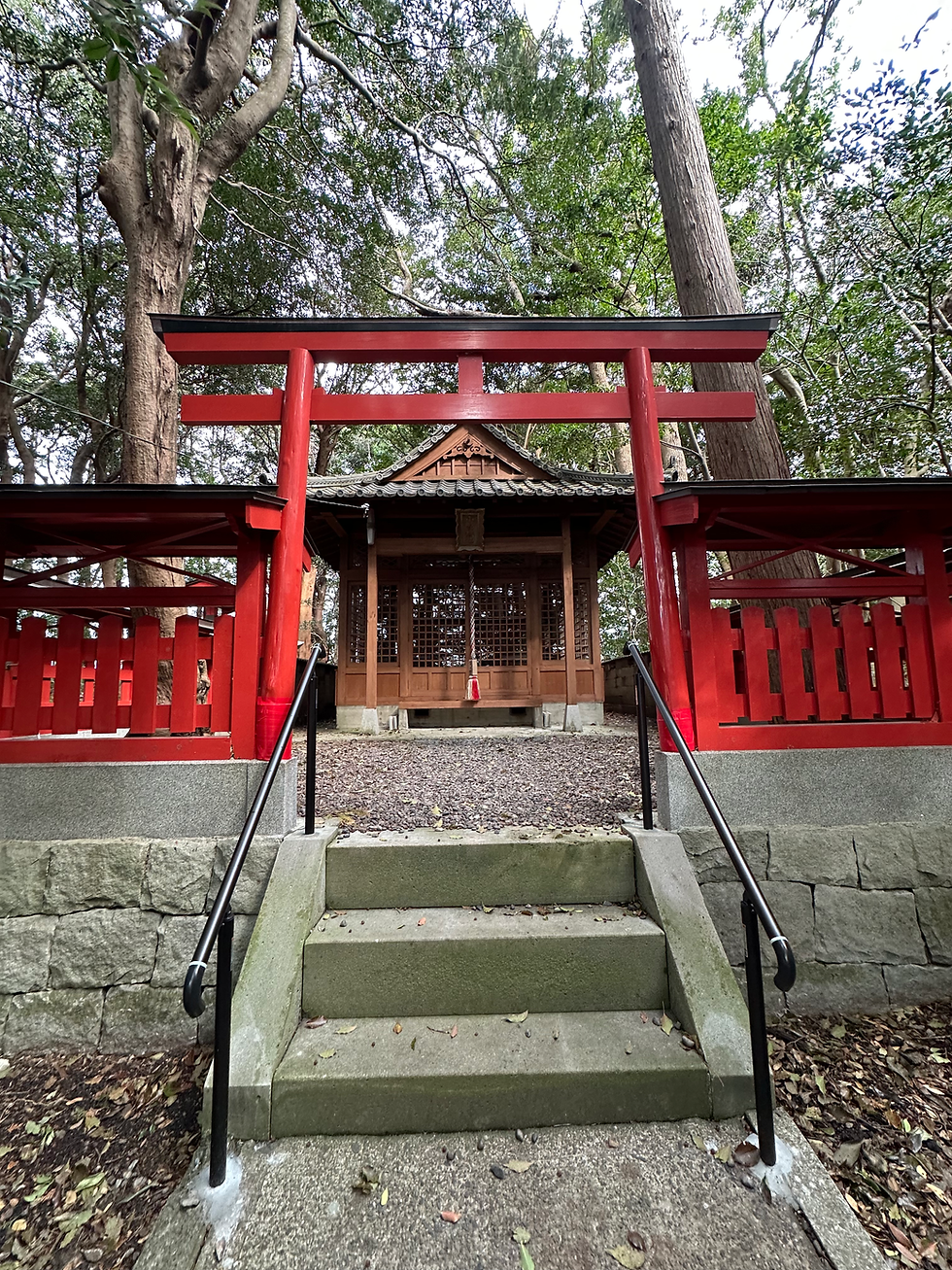
On the way up to the viewpoint, I passed by a small shrine. There was something about it that made me slow down. It felt calm, quiet… almost like it was gently calling me to stop.
So I did.
I stepped inside and stood there for a moment, saying a quiet prayer. The shrine was surrounded by tall, old trees, their branches stretching above and filtering the light. It felt cool and still, like the outside world had faded away.
Next to the shrine, there was a small sign. It said this place is dedicated to a god who cures illnesses, and that it has been here for over 700 years—possibly since 1309.
Standing there, surrounded by trees and silence, it felt like time had softened. Just for a moment, everything was still.

I still saw some ume blossoms along the path. Even though the season was almost over, a few trees were still quietly in bloom. The soft pink flowers stood out against the cloudy sky, adding a gentle touch of color to the calm, grey day. It felt simple, but somehow really beautiful.

Finally, we made it to the top viewpoint. It opened up into a garden surrounded by many ume trees, with soft pink and white blossoms all around.
There were also small shops and food trucks nearby, making it a perfect place to take a break after the long walk from the entrance. It felt relaxed and easy—people sitting, enjoying snacks, and taking their time. A really nice spot to slow down and just enjoy the moment.

Another highlight you really shouldn’t miss is the 'sweet potato mochi cake.' It’s made fresh right at the shop, and you can watch the whole process from start to finish.
People start lining up from early morning, and it’s easy to see why. Warm, soft, and slightly sweet. What makes it even more unique is that the shop only opens once a year, during the same season as Minabe Bairin. It’s one of those small, seasonal treats that you can only experience at that exact moment.
Since the line was so long and we didn’t have much time, we decided to skip it, even though I really wanted to try it.
I remember feeling a little disappointed as we walked away. But later in the evening, something unexpected happened. Morikawa-san, the owner of Morikawa Umeshu, had gone there early in the morning—and he brought back sweet potato mochi cake for us!! We were so grateful and happy.
Time to meet our lovely and hard working Umeshu Producers in Minabe

Time to finally meet our Minabe Umeshu makers.
We first met during the Best Ume Event in Thailand, where everything felt busy and intense. Everyone worked until the very last moment, and all of them flew back to Japan that same night. There was barely any time to sit down, talk, or truly get to know each other.
So this trip felt different.
For PRUMPLUM, it meant so much to come all the way to Minabe—the place where everything begins—and finally meet them again, not just as partners, but as people. We had dinner together, shared stories, and laughed about the days we spent working side by side.
What made the experience truly special was meeting founders and CEOs—each carrying generations of tradition, knowledge, and responsibility. Yet despite that, they were all incredibly warm, humble, and kind. Nothing felt formal or distant—just genuine, easy, and deeply human.
(Nanki Umeboshi, Ume Ichiban, Kumahei, Umeyoshi, Yokoyama Foods, Baijuen, Suzuume, Umeta, Maruryou Nagaoka, Morikawa Farm, Sujimoto Farm, and Ume Domaine Arimoto)
It made me realize even more how PRUMPLUM is built—not just on umeshu, but on relationships. A connection between Thai hospitality and Japanese craftsmanship, brought together through shared passion and trust.
That night, I wanted to properly say thank you—not just as a brand, but from my heart.
I prepared a short speech in Japanese. I was nervous—more than I expected—but also really excited. Standing there, looking at everyone, I just hoped my words could carry even a small part of how grateful I felt.
It wasn’t perfect, but it was real.
And somehow, that made the moment even more special 🤍 "少しだけお話しさせていただきます。
2週間前の「Best Ume」のイベントでは、皆様本当にお疲れ様でした。心より感謝申し上げます。
いつも素晴らしい梅酒を造り、そしてそれをタイの皆様に届けてくださって、本当にありがとうございます。
これからも「一番美味しい梅酒はみなべの梅酒です」と、自信を持って伝え続けていきます。
本日は本当にありがとうございました。" “I’d like to say a few words.
First of all, thank you so much for all your hard work at the ‘Best Ume’ event two weeks ago—I truly appreciate it.
Thank you for always making such wonderful umeshu and for sharing it all the way to Thailand with us.
From now on, I’ll keep proudly telling everyone that the most delicious umeshu comes from Minabe.
Thank you again for today—it really means a lot.” Jinny PRUMPLUM


Author
Jinny PRUMPLUM
Passionate purveyor of Umeshu and Sake at PRUMPLUM Umeshu


Comments